Explore Purulia

Hill · birds

Pakhi Pahar

A bare rock hill carved with giant birds by Chitta Dey's team

Directions
  • 6.5 kmBy road from the resort
  • South-eastOf the resort
  • Hill · birdsHills & views

Overview
Hill · birds

Visiting Pakhi Pahar

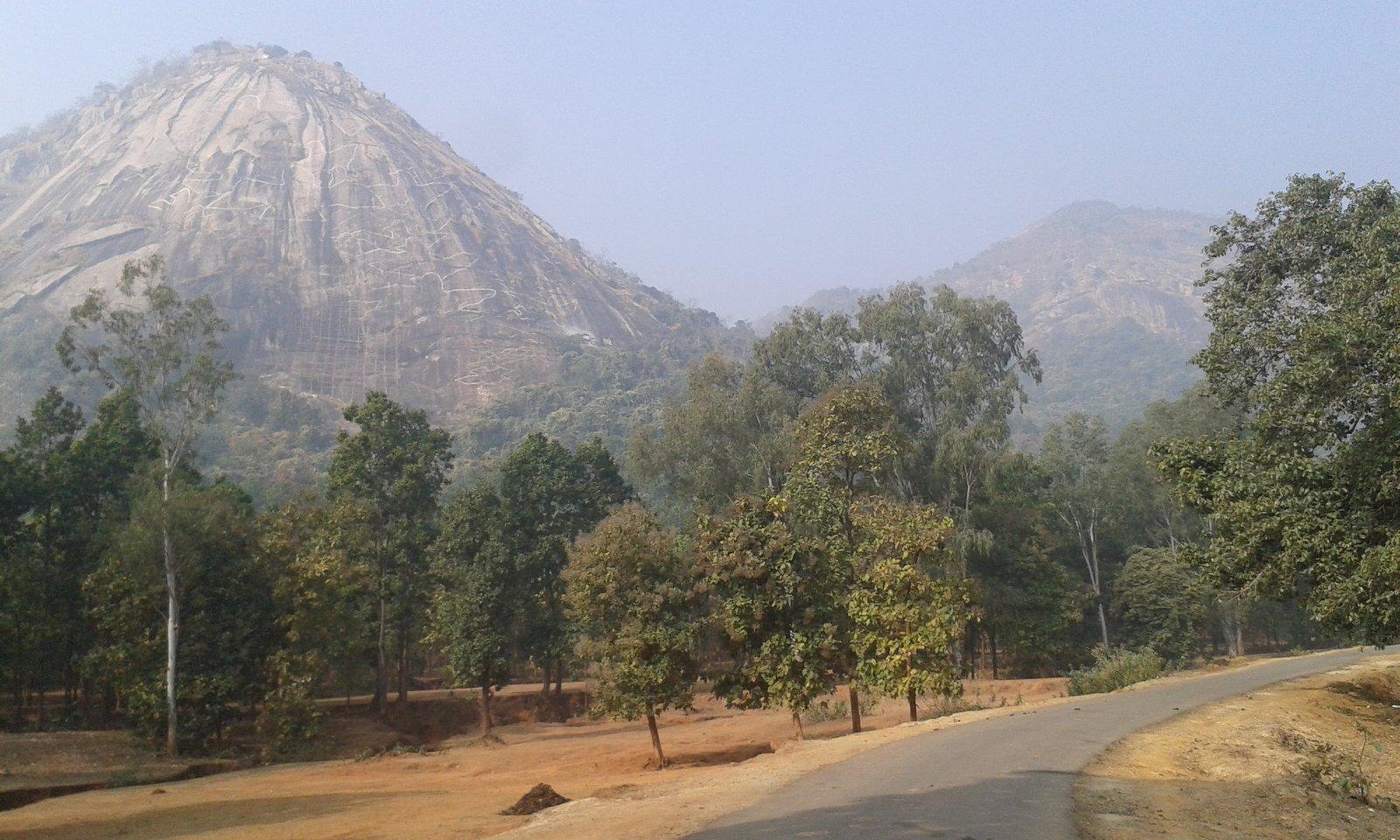
Pakhi Pahar, the 'bird hill', is the popular name of Murraburu, a bare rock hill in the Matha forest. Since the mid-1990s the Kolkata sculptor Chitta Dey and carvers he trained from nearby villages have been cutting enormous birds directly into its face, with animals carved on the boulders below. The figures can be seen from the main road, and local women guide visitors around the site.

Murraburu, a name explained as 'bald hill', is a largely bare hill of about 480 m. On its western face the team marked out a first panel about 800 ft by 600 ft, and across it bird after bird is taking shape, the smallest with a wingspan of about 55 ft and the largest about 120 ft. The plan is a flock of more than a hundred birds, wing to wing.

This is in-situ carving: instead of quarrying stone and sculpting it elsewhere, the team works on the hill itself, hanging in harnesses on ropes. Each bird is studied from all sides for at least a month, drawn on paper, then marked on the rock in yellow, blue and white enamel paint before cutting starts. A single figure can take six months to a year, and work stops in extreme heat and in the monsoon.

At the foot of the hill, scattered boulders carry a second series: peacock, deer, elephant, squirrel, crocodile and the pangolin, chosen because it is threatened. The project has also given work to young people from the surrounding villages, whom Dey trained in carving, climbing and rappelling.
Past & present
History & stories

The story of Pakhi Pahar

Chitta Dey, born in Kolkata in 1957 and trained at the Government Art College there, says the idea of carving a whole hill came to him at the start of the 1990s, when exhibition halls proved too small for his large sculptures. He searched for more than three years before choosing a hill in the Ajodhya range, and permission came in the mid-1990s after many rounds of government offices; accounts give 1995 or 1996.

Between 1995 and 1999 Dey trained about thirty young people from local villages, with friends paying for the training, and the first drawing was finished in 1999. Cutting began only in 2008, when central government funds came through his trust, the Flight to Harmony Foundation. Work then halted for about five years from 2010 because of Maoist activity in the area, resuming in 2015.

In 2015 Dey also opened an arts centre called Aina near the hill to train local youngsters. The state government, the Purulia Zilla Parishad and the panchayat samiti have supported the work, and the government has planted trees and improved roads around the site. Published counts of finished birds vary widely, as carving continues, so none is given here.

The 'mad' man of the hill

Villagers at first thought Dey mad for wanting to carve a hill, and he is still called 'pagla', crazy, with fondness. One of his early trainees, Paresh Mahato, recalled that he nonetheless ate with them and slept on the floor beside them. Dey, for his part, says hills are not lifeless rock but living creatures that inspire his art.

Carving as protection

Dey describes the carving as a way of protecting the hill. He argues that once its rock carries a work of art, nobody will damage or deface it, and he hopes the site will come to be valued as part of India's heritage of rock-cut art, alongside Elephanta and Ajanta–Ellora.

When you're there
See & do

Things to see and do

  1. 01

    The bird panels

    Look up at the rock face to pick out the birds, some finished, others still outlines in paint. They are large enough to be seen from the Balarampur–Baghmundi road.

  2. 02

    The carved boulders

    Walk among the boulders at the foot of the hill to find the animal carvings, including peacock, deer, elephant, squirrel, crocodile and pangolin.

  3. 03

    Walk with a local guide

    Forty-one women from four self-help groups take turns guiding visitors through the hill's forest, explaining the carvings, the trees and the birds and animals of the area. They also clear plastic litter from the forest each morning.

  4. 04

    Carvers at work

    In the cooler, drier months you may see carvers on ropes high on the face; work pauses in extreme heat and in the rains.

Gallery
Photos

Pakhi Pahar in pictures

Pakhi Pahar, photo 1
1 / 1

Getting there
From Rangamati

Where it lies

Pakhi Pahar is 6.5 km by road from the resort, to the south-east. A local guide, sightseeing cab or driver can be arranged on request.

The drive
The hill stands just off the Balarampur–Baghmundi road (SH4), a short drive south-east of the resort towards Balarampur. A side road leaves the highway at Bhuchungdi More and runs a short way to the foot of the hill; coming from the resort, the hill lies to the left of the highway.
The last stretch
The bird figures are visible from the main road. Guides lead walks from the foot of the hill among the carved boulders and into the surrounding forest.
Open in Google Maps
10 km25 km50 km100 kmNPakhi Pahar
Rings show straight-line distance from the resort; the road is longer.

Before you go

Entry
No entry fee is documented. As of 2023 the women's guide service charged ₹100 per vehicle, however many people were in it.
Timings
In 2023 the guides began their shifts at about 10 am.
Facilities
Facilities near the hill are limited, so carry water and snacks.
Getting around
The main panels can be seen from the roadside, so even visitors who cannot walk far can see the birds.

Through the year
Seasons & festivals

When to go

  • Summer

    March – June

    Carving pauses in extreme heat, so a visit between April and June is less likely to find the team at work.

  • Monsoon

    July – September

    Work also stops in the rains, when the rock is too dangerous for carvers on ropes.

  • Winter

    October – February

    The busiest tourist season in the Ajodhya hills, and a comfortable time for a guided walk around the hill.

Good to know
Questions

Frequently asked questions

How far is Pakhi Pahar from Rangamati Eco Resort?

About 6.5 km by road, along the Balarampur–Baghmundi road.

Who carved the birds?

The Kolkata sculptor Chitta Dey, with a team of carvers from nearby villages whom he trained himself. The project has been under way since the mid-1990s, and the cutting of the rock since 2008.

Is there an entry fee?

No entry fee is documented. In 2023 the women's guide service charged ₹100 per vehicle for a guided walk; check the current rate on arrival.

Is it suitable for elderly visitors and children?

Yes, at least in part: the bird panels can be seen from the main road, and the carved boulders are at the foot of the hill. The guided walk into the forest is optional.

Can we see the carvers at work?

Possibly. The team works in harnesses on the rock face but stops in extreme heat and in the monsoon, so the cool, dry months give the best chance.

Can it be combined with Matha Buru?

Yes. Both hills are in the Matha forest near the resort, and the resort can arrange a cab or guide for a short circuit.

Make a day of it
Close by

Nearby places

Other places close to this one, so you can see a few in a single trip.

On our suggested itineraries

Sources: en.wikipedia.org · thebetterindia.com · openstreetmap.org · en.wikivoyage.org · outlookindia.com · commons.wikimedia.org · theweekendleader.com · everythingexperiential.com · sangbadpratidin.in · en.wikivoyage.org · openstreetmap.org · router.project-osrm.org

Make Rangamati your base.

Rangamati is your base for the Ajodhya hills — tell us your dates and we'll plan the drive.

WhatsApp us

Book your stay

Check availability

Check-in 10:00 AM · Check-out 9:00 AM · Meal package ₹1,600 per head / per day

Opens WhatsApp with your details filled in. Prefer to talk? Call +91 96417 88198