At a glance
- Purulia's oldest temples are ruined deuls of stone and brick, dated by scholars to roughly the 9th to 12th centuries; none has a firm founding inscription.
- Deulghata, 44 km from the resort, has two tall brick deuls with fine moulded-brick work on the Kangsabati.
- Banda Deul, a c. 11th-century sandstone temple, is the district's only monument on the ASI's national list; Pakbirra, Para, Cheliyama and others are state-protected.
- Telkupi's temples were drowned by the Panchet reservoir in 1959; two still stand in the water and can be reached by country boat from Lalpur.
- Most sites have no toilets, food or guides, and several images are still worshipped, so carry water and visit as you would a working temple.
The ancient temples of Purulia are mostly ruined deuls, tall curved temple towers of stone or brick, built between roughly the 9th and 12th centuries, along with a few later terracotta temples. The best known are the brick towers of Deulghata on the Kangsabati, the Jain temples of Pakbirra, the sandstone Banda Deul, the drowned temples of Telkupi and the terracotta temples of Cheliyama and Garh Panchkot. Few have any facilities and several are still places of worship, so this guide covers what survives, how old it is, how to combine the sites and how to visit well.
Ancient temples of Purulia at a glance
| Site | What you see | Age, per sources | Road distance from the resort |
|---|---|---|---|
| Deulghata | Two brick deuls, stone sculpture | c. 9th–12th century | 44 km |
| Suisa and Deuli | Jain images, ruined temples | Jain heritage of c. 10th–13th century | about 30 km |
| Pakbirra | Three Jain temples, colossal Jina | c. 9th century | about 85 km |
| Budhpur | Ruined Shiva temple on the Kangsabati | 12th–13th century, per Beglar | about 75 km |
| Para | Stone and brick deuls | Early deul style; undated | about 85 km |
| Banda | Sandstone deul and mandapa pillars | c. 11th century | about 110 km |
| Cheliyama | Terracotta Radha Vinod temple | Saka 1619 (about 1697 CE) | about 110 km |
| Garh Panchkot | Terracotta pancharatna temple, fort ruins | Panchkot Raj era | 110 km |
| Telkupi | Temples standing in the Panchet reservoir | Trading town of the 10th–13th centuries | about 130 km |
Only Deulghata and Garh Panchkot distances come from our own measured list; the rest are route-planner estimates, so allow extra time.
What is a deul? A quick guide to the styles
The early temples of western Bengal follow the rekha deul form: a single sanctum under a tall, curving tower decorated with a mesh of chaitya window motifs and crowned by a large ribbed disc (amalaka) and a pot-shaped finial (kalasa). The historian David McCutchion traced this style from the late 7th or early 8th century to around the 12th, the towers growing taller and more complex over time.
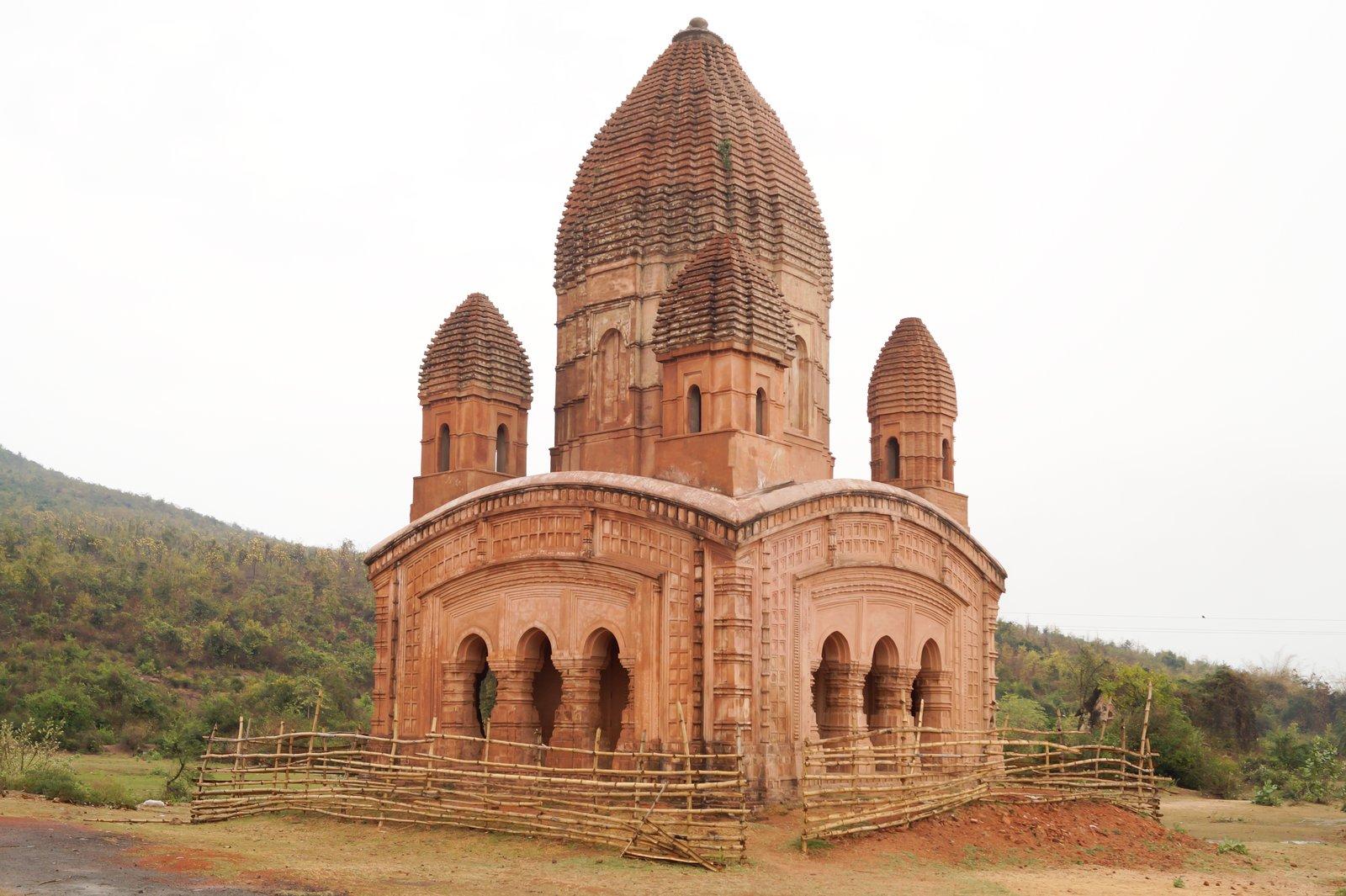
Most were built in stone, but a group of brick deuls stands out for its fine stucco on carved brick, and McCutchion names Deulghata and Para among them. Centuries later, Bengal's builders turned to new forms: the aatchala, with an eight-part curved roof, and the five-spired pancharatna, both covered in terracotta panels. Cheliyama and Garh Panchkot show this later style.
Deulghata: brick towers on the Kangsabati
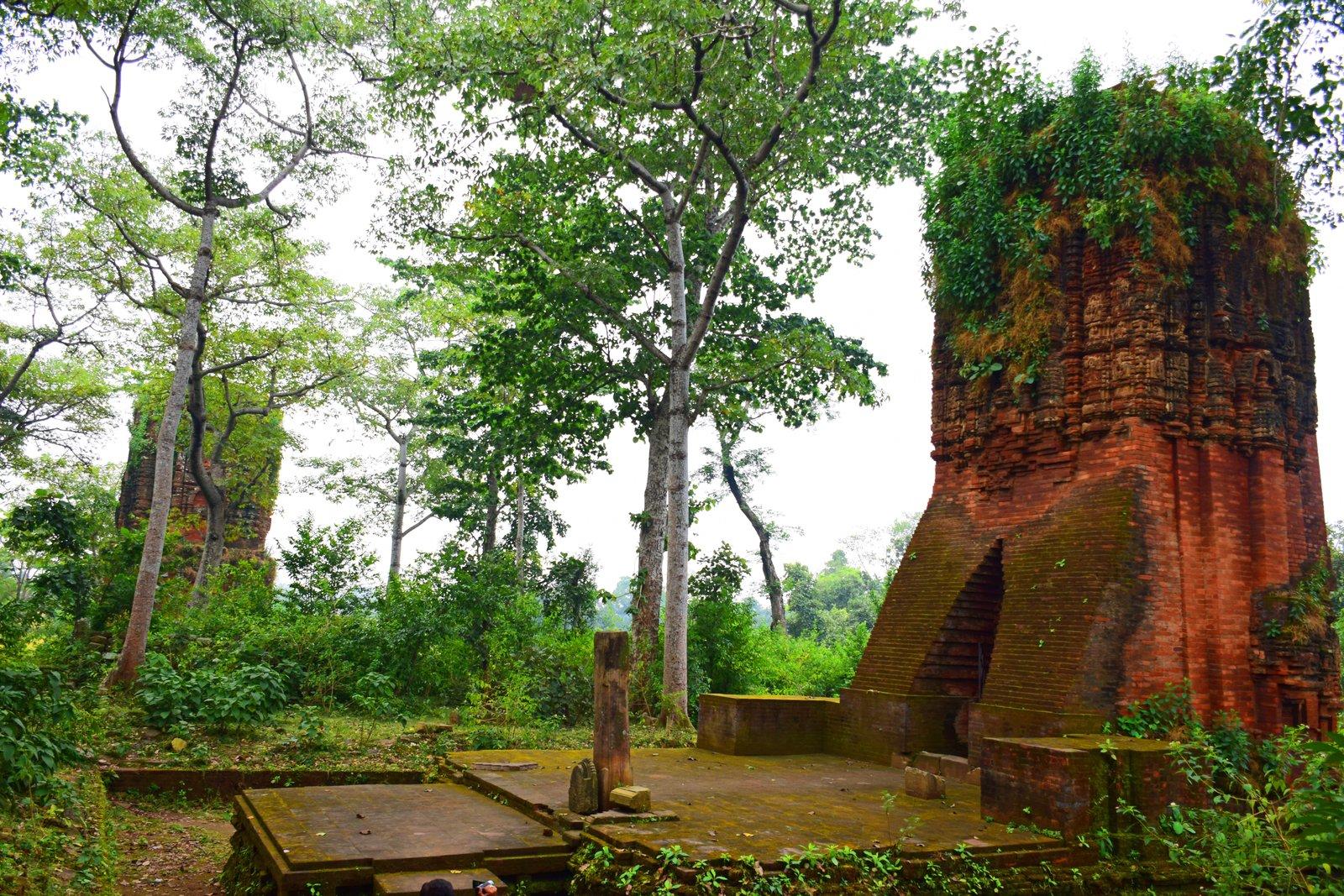
Deulghata, near Boram village in Arsha block, is the most rewarding early site within easy reach of the Ajodhya Hills. Two east-facing brick rekha deuls rise among trees at the edge of paddy fields, decorated almost entirely in moulded brick: tiers of miniature temple towers, scrollwork, geese and, over the southern doorway, a fanged kirtimukha face. A third tower collapsed in 2002.
Colonel E. T. Dalton described "three very imposing looking brick temples" here in 1864–65, and J. D. Beglar of the Archaeological Survey recorded them in 1872–73. Beglar found only Hindu images, among them a large eight-armed Durga slaying Mahishasura, which is still worshipped; local people told Dalton the temples were built by Jains, but no Jain image has been found. Estimates of age run from the 9th–10th to the 11th–12th centuries.
The site is quiet for most of the year and fills at the Tusu fair at Makar Sankranti and at Dol Jatra. There are no eateries or toilets, and the towers are fragile, so admire them from the ground. Deulghata pairs well with Murguma Dam, and our guide to Tusu Parab covers the January fair.
Are there Jain temples in Purulia?
Yes, and they are among the district's most important remains. Scholars describe Purulia as a significant Jain centre between roughly the 6th and 13th centuries, and many of the stone images found in its villages are of the tirthankaras.
Pakbirra, in Puncha block about 40 km from Purulia town, has a group of three stone temples in the triratha nagara style, dated to around the 9th century. C. J. Beavan reported the ruins in 1865, and Beglar recorded a colossal standing Jina about 7.5 ft tall, identified as Padmaprabha by the lotus on its pedestal; local Hindus worship it as Bhairavnath. Smaller images of Rishabhanatha, Mahavira and other tirthankaras, an Ambika and votive shrines are kept on site. Pakbirra is also where the Bengali language movement was born in 1948, as our history of Purulia explains.
Budhpur, 11 km south of Pakbirra on the north bank of the Kangsabati, once had a large Buddheswara Shiva temple with a mandapa and four corner shrines, which Beglar dated to the 12th or 13th century. The main temple has virtually fallen, a rough stone tower was put up in place of the old one in 1926, and the enclosure is strewn with carved blocks.
Suisa and Deuli, in Baghmundi block and only about 30 km from our cottages, are the closest Jain sites to the Ajodhya Hills. Statues of tirthankaras gathered from the area are kept in a one-roomed museum at Suisa, a state-protected collection. At nearby Deuli, Outlook Traveller found three simple temples, one ruined, with a large tirthankara image in the sanctum that local people worship as Shiva.
Banda, Cheliyama and Para: the Raghunathpur cluster
Banda Deul, in Raghunathpur II block, is the only monument in Purulia on the Archaeological Survey of India's list of Monuments of National Importance. It is a sandstone rekha deul of the triratha type, dated to about the 11th century, decorated with creepers, scrollwork and chaitya windows. When Beglar found it in 1872 it was buried in forest. Its mandapa has collapsed, but eight pillars still carry the cross-beams, and a water spout is carved as a makara, a crocodile-like creature. Whether it was built as a Hindu or a Jain temple is not clear.
Cheliyama, 1 km away, has the Radha Vinod temple, an aatchala temple dated Saka 1619, about 1697 CE. Its terracotta panels show the Ramayana war and scenes from Krishna's life. Many panels have weathered, and some have been replaced with new terracotta, which Outlook Traveller's writer regretted; look closely to tell old from new.
Para, in Para block, keeps three temples: a stone deul, a brick deul and a smaller third shrine. McCutchion singled out the brick deul at Para, with Deulghata, for its remarkably fine stucco on carved brick, and Beglar photographed the stone temple in 1872–73. At nearby Haraktore, 10th-century-style images of Jain and Hindu deities are kept in the Basanti temple.
Is Telkupi still underwater?
Mostly, yes. Telkupi, on the south bank of the Damodar, was once a trading town on the route between Bihar and Orissa, and Beglar described it as containing perhaps the finest and largest number of temples within a small space in the whole Chota Nagpur circle. He listed more than twenty; when the archaeologist Bloch visited in 1902, about ten were still well preserved.
The Panchet dam on the Damodar changed everything. By early 1959 the rising reservoir had reached the temples, and the archaeologist Debala Mitra documented them on visits that year, publishing her study through the Archaeological Survey. Today the district administration counts two temples standing at the water's edge and a third half-submerged; LiveHistoryIndia notes that the third temple's spire shows only at the peak of summer, when the water is low.
Telkupi is about 55 km from Purulia town, by way of Raghunathpur, and about 8 km north-east of Cheliyama. From Lalpur village, local boatmen took visitors out in country boats for a small fee as of 2022, and salvaged images are kept in a small temple at Gurundi on the way.
Garh Panchkot's temples
Garh Panchkot, 110 km from the resort at the foot of Panchet Hill, belongs to a later age. Its best-known monument is a five-spired brick pancharatna temple with terracotta panels of dancers and musicians, declared a heritage site by the West Bengal Heritage Commission in 2010. The shell of a second pancharatna temple, the ruined Kankali temple of the rajas' family deity and the fort's gateways lie nearby. For a full day plan, see our Garh Panchkot and Baranti day trip.
Which temples are officially protected?
Banda Deul is protected by the Archaeological Survey of India. West Bengal's state-protected list for Purulia includes the Durga temple at Para, the Haraktore mound, the Radha Gobinda (Radha Vinod) temple at Cheliyama, the Shiva temple at Kroshjuri, the Jain temple at Pakbirra, the ruined Basudeb temple at Arsha, the Jain and other images at Suisa and the Rashmandir at Begunkodar, near Jhalda. Deulghata's status is unclear: sources disagree on whether any authority looks after it.
How to plan a temple trail from the Ajodhya Hills
The sites are spread across the district, so group them by direction:
- Half day, close by: Suisa and Deuli, west of Baghmundi, about 30 km away.
- Half day, north: Deulghata, 44 km, combined with Murguma Dam or the Ajodhya Hills on the way.
- Long day, east: Pakbirra and Budhpur, by way of Manbazar.
- Long day or overnight, north-east: Garh Panchkot, Banda, Cheliyama and Para, with Telkupi if the water and a boat allow.
A few habits make these visits easier:
- Carry water and snacks. Almost none of these sites has a shop, café or toilet.
- Treat them as temples. Images at Deulghata, Pakbirra and Deuli are worshipped; take off your shoes where asked and do not touch offerings.
- Ask before photographing people at worship or at work in the fields around the sites.
- Do not climb the ruins. Brick towers have collapsed at Deulghata within living memory.
- Be back on main roads by dusk. Village and forest roads are poorly lit, and elephants move through parts of the district after dark.