At a glance
- Chhau, in its Purulia, Seraikella and Mayurbhanj styles, was inscribed on UNESCO's Representative List of the Intangible Cultural Heritage of Humanity in 2010.
- Purulia Chhau is known for its large, ornate masks made in Charida village, and for vigorous leaps, turns and mock combat.
- The music is led by reed pipes (shehnai and mohuri) over dhol and dhamsa drums; performances run through the night on open ground.
- The traditional season runs from Chaitra Sankranti in mid-April to the end of Jyeshtha in mid-June, with troupes busy from roughly January to June.
- Padma Shri dancers Gambhir Singh Mura (1981) and Nepal Mahato (1983) took Purulia Chhau to stages across Europe, Asia and North America.
Purulia Chhau dance is a masked dance-drama from the Purulia district of West Bengal, performed by night on open village ground to the thunder of dhol and dhamsa drums and the cry of the shehnai. Dancers in large painted masks act out battles from the Ramayana, the Mahabharata and the Puranas with high leaps, turns and acrobatics. Together with the Seraikella and Mayurbhanj styles, Chhau was inscribed by UNESCO in 2010 on its Representative List of the Intangible Cultural Heritage of Humanity. The traditional season starts in mid-April, and the masks are made at Charida, a short drive from the Ajodhya Hills.
What is Purulia Chhau dance?
Chhau is a dance tradition of eastern India, found in Jharkhand, Odisha and West Bengal. UNESCO's description gives the essentials: it enacts episodes from the epics and from local folklore, it is performed at night in an open space, its dancers are male, and it is closely tied to the spring festival of Chaitra Parva. Its movement draws on mock combat, the gaits of birds and animals, and gestures taken from the daily work of village women.
In Purulia the dance is part of village life rather than a stage art that happens to be rural. West Bengal Tourism calls it "an inseparable part of the rituals and the festivities of Purulia" and notes that many consider it comparable to a martial art because of the strength and agility it demands. The Folk Library of the state's Rural Craft and Cultural Hubs project lists more than 5,000 Chhau artists in Purulia alone.
The stories are simple — good defeats evil — but the telling is not. As Outlook Traveller put it, what makes the dance dramatic are the gestures and the movements: martial footwork, sudden leaps and fights that build to a single decisive blow.
Purulia, Seraikella and Mayurbhanj: the three Chhau styles
UNESCO's listing covers three regional styles, named after the places that shaped them. They share a root but look strikingly different.
| Style | Where | Masks | What stands out |
|---|---|---|---|
| Purulia Chhau | Purulia district, West Bengal | Large, ornate masks with tall headdresses | Athletic leaps and acrobatics, battle scenes, loud drums |
| Seraikella Chhau | Seraikela, Jharkhand | Smaller, simpler, symbolic masks | A refined technique developed with the former royal family |
| Mayurbhanj Chhau | Mayurbhanj, Odisha | No masks | Technically close to Seraikella, with the face left bare |
The masks are the quickest way to tell them apart. Outlook Traveller sums it up neatly: Purulia masks are large and elaborately designed, while Seraikella's are smaller with minimal embellishment.
Where does the name Chhau come from?
Nobody is certain. One theory traces it to the Sanskrit chhaya, meaning shadow, image or mask; another to chhadma, meaning disguise. The Odia writer Sitakant Mahapatra suggested chhauni, a military camp, which fits the dance's combat movements and its reputation as a warrior's art.
The Folk Library notes that Purulia Chhau is believed to be more than a century old, though its exact origins cannot be pinned down. Its masks have a clearer story. Mask making at Charida is traced to the reign of King Madan Mohan Singh Deo of Baghmundi, about 150 years ago, and the royal family of Baghmundi is remembered as an early patron of the craft.
The masks: Purulia Chhau's signature
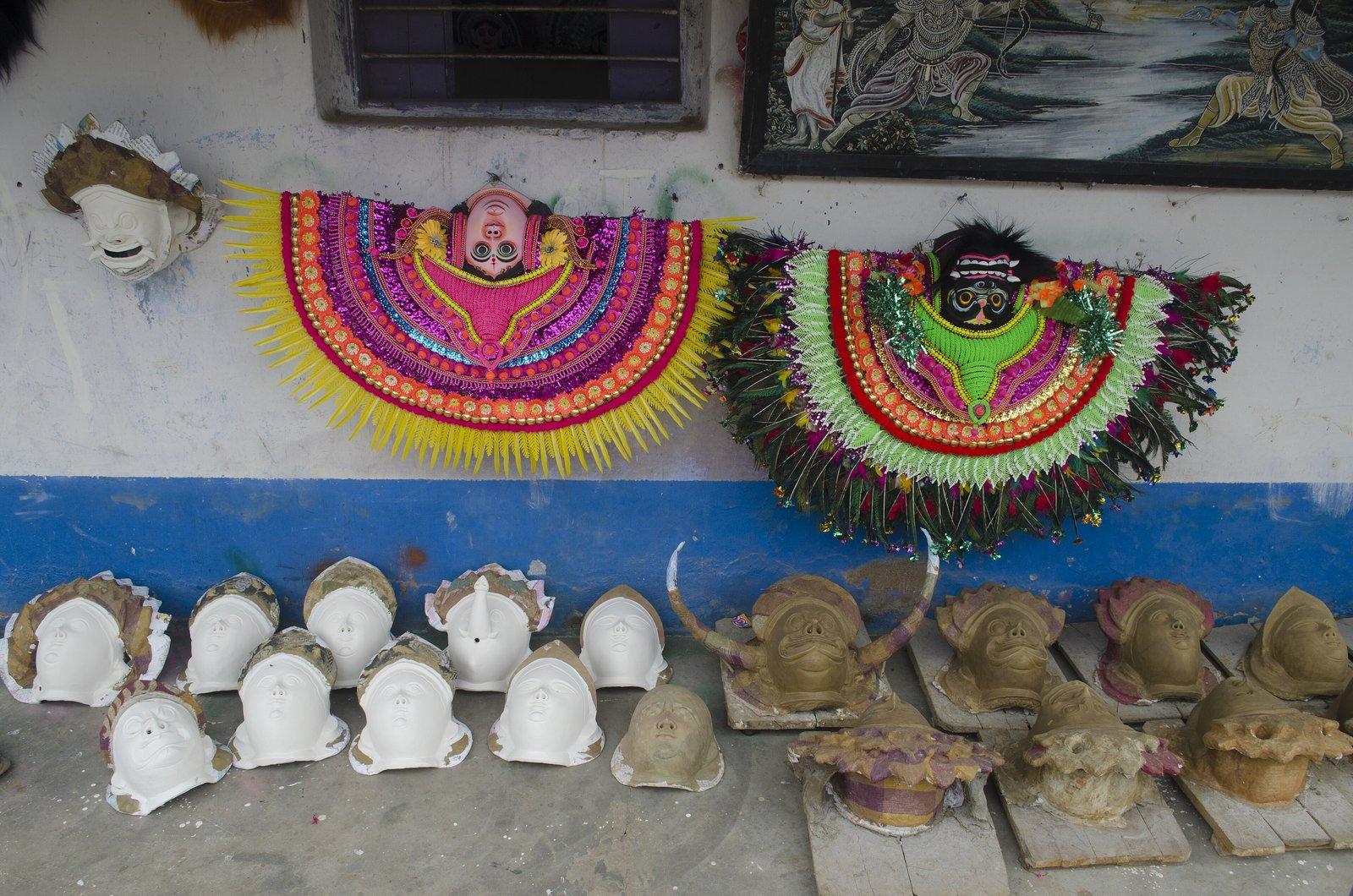
A Purulia Chhau mask is a character in itself. Gods and goddesses carry finely painted faces and crowns heavy with beads, tinsel and artificial flowers; demons have bushy eyebrows and moustaches. Some of the beaded headdresses weigh up to five kilograms, which makes the dancers' leaps all the more remarkable. Animal characters go further still: a lion wears a lion mask and a full lion costume and moves on all fours.
The masks are made from clay moulds, layers of paper and cloth, and paint, by mask-making families of the Sutradhar community in Charida, the Chhau mask village. The Purulia Chhau mask carries a Geographical Indication (GI) tag, and a Chhau mask appeared on an Indian postage stamp in 2017. We go through the craft step by step in our post on Charida's mask makers.
Music: dhol, dhamsa and shehnai
Chhau is danced to an outdoor band built for open fields and big crowds. UNESCO lists reed pipes, the mohuri and shehnai, over an ensemble dominated by drums. In Purulia that means the dhol, a cylindrical drum, and the dhamsa, a large kettle drum whose boom carries across the village, with the chad-chadi or kharka completing the ensemble.
The drummers do more than keep time. They follow the dancers, building tension as a fight closes in and crashing on the decisive blow. The veteran dancer Dhananjoy Mahato of Belgara, who died in 2020 at 85 after a career of seven decades, insisted on dhamsa and shehnai and argued that synthesisers would dilute the dance's earthiness. That debate between old instruments and new sound systems is still alive.
Purulia's songs and Chhau are close relatives. Banglapedia lists a "Chhau jhumur" among the district's song variants; read more in our guide to Jhumur, the folk songs of Manbhum.
What happens on a Chhau night?
A village performance usually begins late, around 9 or 10 pm, and runs for hours, gathering energy as the night goes on. The arena, called an akhada or asar, is a patch of open ground with the audience sitting around it. In earlier times it was lit by torches that burned all night.
Performances open with an invocation to Ganesh. Then come the stories. Mahishasuramardini, Durga's battle with the buffalo demon, is a favourite, as are episodes from the Ramayana and the Mahabharata. Kirat and Kiratni, Shiva and his consort in the guise of hunters, were by Charida's own tradition the first masks ever made in the village.
Turns and acrobatics are central, and the drums push the fights towards their climax. Between the big battles you may see lighter pieces built on the gaits of birds and animals, which UNESCO lists among the dance's building blocks.
Famous Purulia Chhau dancers
A handful of dancers carried Purulia Chhau from village grounds to the world's stages.
- Gambhir Singh Mura (1930–2002), of Pitikiri Bamni, received the Padma Shri in 1981 and performed in England, France, Japan and the USA. His statue stands in Charida.
- Nepal Mahato, of Adabona village, received the Padma Shri in 1983. He set up his own troupe in 1974–75, became known for his Mahishasuramardini and a lion dance, and took his dancers to England, Canada, France, Switzerland, Thailand and Russia. He died in March 2019, aged 66; his sons and grandson dance in his troupe.
- Dhananjoy (Dhunda) Mahato of Belgara learned from his father, began practising at 13 and danced for seven decades.
Behind these names stand thousands of village dancers, drummers and mask makers whose work rarely makes the news.
Women in Purulia Chhau
For most of its history Purulia Chhau was danced only by men, with men also playing the goddesses. That has begun to change. Since the 2010s women's troupes have formed in the district, the best known being the Mitali Chhau group from Maldi village in Balarampur block; sources date its founding to 2010 or 2014.
A 2024 academic study of the troupe describes the resistance the women faced and how they often perform stories of Durga and Kali, presenting their place in the dance in terms that devout audiences accept. Several more women's groups have followed.
When and where to watch Purulia Chhau dance
The season. Traditionally, Chhau festivals begin on Chaitra Sankranti, the last day of the Bengali year in mid-April, and end on the last day of Jyeshtha in mid-June. The timing lets dancers return to their fields when the rains arrive. Troupes are busiest from roughly January to June, and in winter, Purulia's main travel season, the Charida mask festival brings Chhau to the mask village. See our month-by-month guide to the best time to visit Purulia.
Where to look:
- Gajan fairs. The Lahariya Shib Mandir, 10 km from the resort below the Lower Dam, holds a Gajan and Charak fair before Chaitra Sankranti with an all-night Chhau performance that draws thousands.
- Charida. The mask makers' collective hosts a mask festival with Chhau and Jhumur, usually in winter or early spring. Dates vary from year to year, so check locally.
- Village performances. Many are organised for local festivals and are not advertised online. Ask local drivers and guides in the Ajodhya Hills area what is on during your stay.
- At the resort. We can arrange a Chhau performance on the lawn for guests on request; it is chargeable, so ask when you book. See our experiences for the other evening programmes.
How to watch Chhau respectfully
A Chhau night is a community event before it is a show for visitors. A few simple habits help.
- Sit where the organisers ask you to and never walk across the arena while a performance is on.
- Ask before photographing dancers and audience members up close, and keep the flash off; masked dancers see only through small eye holes.
- If there is a collection for the troupe or the festival, contribute. Many dancers also farm, and the season is planned around their fields.
- Buy masks directly from the families who make them at Charida rather than from middlemen.
- Keep music off your phone, and take your rubbish back with you.
Chhau is one thread in Purulia's culture. To place it among the district's festivals, songs and crafts, start with our Purulia travel guide or what to buy in Purulia.