At a glance
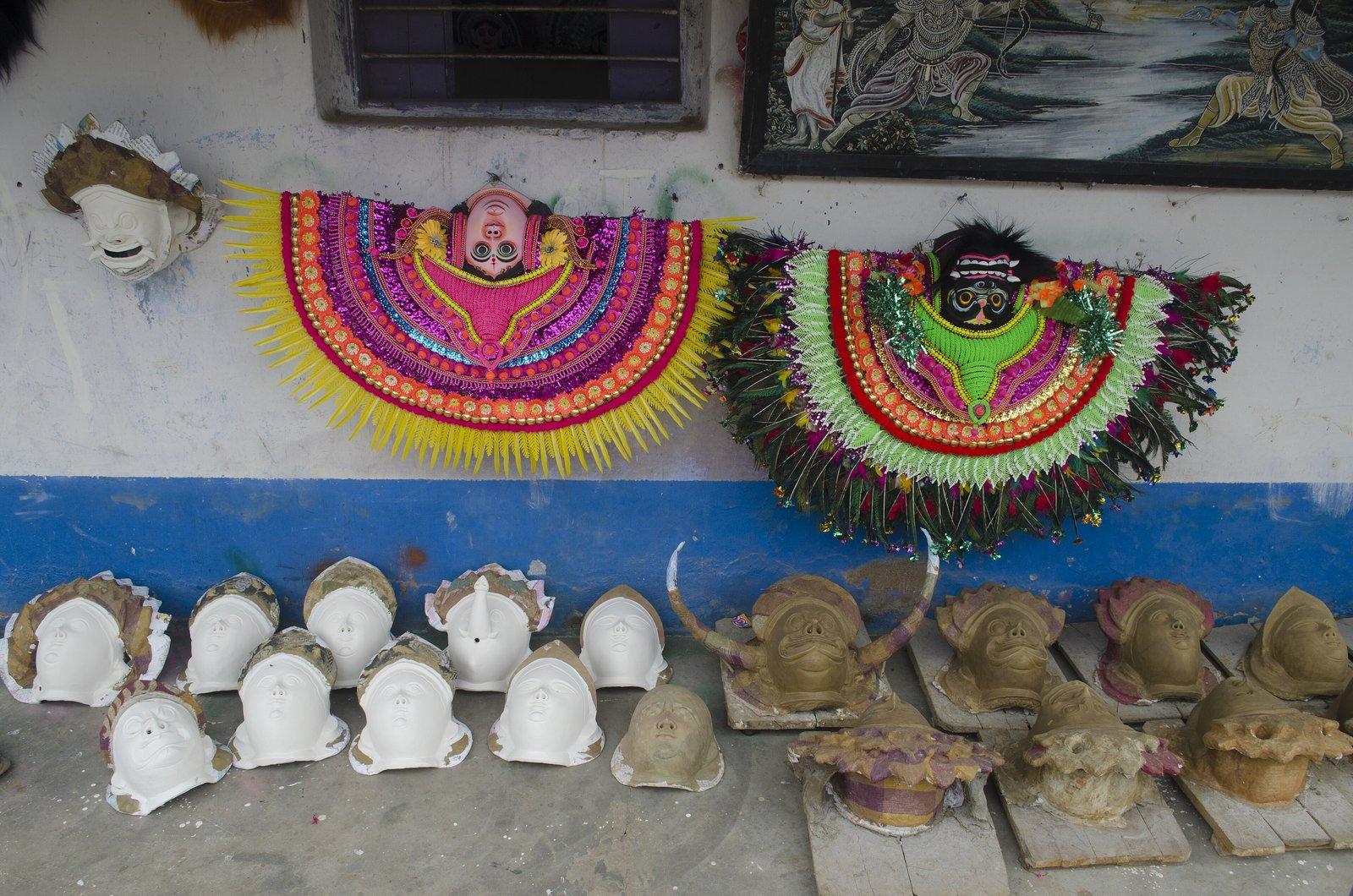
- The Chhau mask is Purulia's signature craft: a registered Geographical Indication made by hand at Charida, 10 km from the resort.
- In 2019 Charida masks cost from about ₹20 for small pieces to ₹5,000 for large dance masks; prices have risen since, so compare a few workshops.
- The state's export plan for Purulia lists a tussar handloom cluster at Raghunathpur, cotton handloom and bell-metal clusters at Kashipur, and sal-leaf and sabai-grass work.
- Purulia produces about 90% of West Bengal's lac and 'Lac of Purulia' is now a registered GI, but it is mostly sold as a raw material, not a souvenir.
- Buy from the makers, carry a mask in your hand luggage, and keep it dry; the beaded headdress is the most fragile part.
Purulia handicrafts are led by the Chhau mask, a registered Geographical Indication made by hand in Charida village, 10 km from our resort at the foot of Matha Buru. Beyond masks, the district weaves tussar silk around Raghunathpur and cotton handloom at Kashipur, casts bell-metal utensils at Kashipur, and makes sal-leaf plates and sabai-grass goods. This guide covers what is worth buying, where it is made, roughly what it costs and how to get a fragile mask home in one piece.
Purulia handicrafts at a glance
| Craft | Where it is made | Good to know |
|---|---|---|
| Chhau masks | Charida, Baghmundi block | GI registered in 2018; buy from the makers |
| Tussar silk fabric and saris | Raghunathpur; Nonduara near Joychandi Pahar | Silkworms are reared on arjun trees |
| Cotton handloom | Kashipur | Gamchha, saris, lungis and bed sheets |
| Brass and bell-metal utensils | Kashipur | Listed as a metal-craft cluster |
| Sal-leaf plates and bowls | Several village clusters | Light, compostable and cheap |
| Sabai-grass crafts | A sabai craft project in the district | Ask locally where to find them |
| Lac | Balarampur and Jhalda | A raw material for industry rather than a souvenir |
The clusters above are those listed in the West Bengal government's District Export Action Plan for Purulia.
Chhau masks from Charida
Charida, about 5 km beyond Baghmundi on the main road, is where the masks of the Purulia Chhau dance are made. Workshops and shops line about 3 km of the road, and in most of them you can watch the work: a clay mould dusted with ash, layers of glued paper, clay and cloth, sun-drying, then painting and decoration with beads, tinsel and feathers. Our guide to the Charida Chhau mask village explains each step.
You will find far more than dance masks. Workshops make palm-sized souvenirs, gods and goddesses, demons and animals, Kathakali-style faces and the popular "Santhal" couple masks, which an elderly artisan explained are modelled on Kirat and Kiratni, forms of Shiva and his consort. Full performance masks with towering beaded headdresses can weigh up to 5 kg, and are traditionally made to fit the dancer who will wear them.
The Purulia Chau mask is a registered Geographical Indication. The application, from the Chau Mukhosh Shilpi Sangha of Charida, was filed on 17 August 2016 and registered in 2018 as certificate no. 318. In 2019 prices at Charida ran from about ₹20 for small pieces to ₹5,000 for large masks; expect more today, and more again for finer, heavier work.
How to buy a mask fairly
Charida's makers sell directly, so a little care goes a long way:
- Walk the whole road. Workshops further into the village get fewer visitors than the first roadside shops.
- Ask what you are buying. A decorative wall mask and a dance mask are different products, and the maker will tell you which is which.
- Bargain lightly, if at all. Asking for a better price on several pieces is normal; haggling hard over a ₹50 mask takes money from a family workshop.
- Ask before photographing artisans at work or the inside of homes, which double as workshops.
- Carry some cash in case a small workshop cannot take a digital payment.
Tussar silk and handloom
The state's export plan names Raghunathpur, in the north of the district, as the place that stands out for tussar silk, and lists a Raghunathpur handloom cluster making tussar fabric, saris and dress material. Sericulture is mainly a rural occupation here.
Near Joy Chandi Pahar, 95 km from the resort, Kolkata on Wheels found silkworms being reared on arjun trees at Nonduara village in 2019, with households about 3 km from the hill weaving tussar on handlooms. It is worth a stop if you are visiting the hill or Garh Panchkot; see our Garh Panchkot and Baranti day trip for a route.
Kashipur, the later seat of the Panchkot rajas, has a cotton handloom cluster making gamchha, saris, lungis and bed sheets. A handwoven gamchha is one of the most useful souvenirs of rural Bengal: light, quick-drying and cheap.
Bell metal, sal leaf and sabai grass
Kashipur also has a brass and bell-metal cluster making household utensils. Bell metal is heavy, so it is a better buy if you are travelling by car than by train.
Sal-leaf plates and bowls, stitched and pressed from the leaves of the forest's main tree, are made by several village clusters across the district. They are light and compostable, and make a good, practical thing to take home for a party.
The export plan also lists a sabai-grass craft project. Sabai is a tough local grass; ask in Baghmundi or at a fair where its products are sold, since we could not confirm a fixed outlet.
What about Purulia lac?
Purulia produces about 90 per cent of West Bengal's lac, the resin secreted by lac insects, and the state puts the number of lac workers at about 70,000. "Lac of Purulia" was filed for a Geographical Indication in 2022 by a shellac cooperative at Balarampur, on our road to Purulia town, and is now registered.
Most of it is processed into shellac and button lac and sold in bulk as a raw material, and processing units, not craft shops, are where it is handled. It is part of the story of the district, as our history of Purulia explains, rather than a souvenir to hunt for.
Where to buy in and around Purulia
- Charida workshops, 10 km from the resort: the best place for masks, bought straight from the makers. The community museum in the village shows old masks and the stages of the craft.
- Joychandi Pahar tourism festival, 28 December to 1 or 2 January: the 18th edition in 2023 had more than 200 stalls, including a crafts market.
- Tusu and other village fairs: stalls of local goods appear at riverside fairs around Makar Sankranti; see our guide to Tusu Parab.
- In Kolkata: if you run out of time, Outlook Traveller suggests the state-run Biswa Bangla stores and Manjusha outlets for Chhau masks.
How to pack a Chhau mask for the journey
Masks are made of paper, clay and cloth, so they are light but easy to crush or spoil with damp:
- Ask the maker to wrap the mask well.
- Pack the headdress so nothing presses on the beads, tinsel and feathers, which break first.
- Fill the hollow of the mask with soft clothes to stop it flexing.
- Keep it dry, especially in the monsoon, and away from the car's floor.
- Carry it in hand luggage on a train or flight rather than in a checked bag.