At a glance
- The Purulia Pumped Storage Project is a 900 MW plant (four 225 MW reversible units) in the Ajodhya Hills, run by WBSEDCL.
- It pumps water up from the Lower Dam to the Upper Dam with surplus power and runs it back down through the turbines at peak hours.
- Main works ran from May 2002 to December 2007; the units entered commercial operation between October 2007 and February 2008.
- It was financed largely by Japanese ODA loans signed in 1995, 2004 and 2006, which is why OECF, JBIC and JICA are all credited.
- Visitors see the two reservoirs from the road (Lower Dam 11 km, Upper Dam 16 km from the resort); the underground power house is not a tourist site.
The Purulia Pumped Storage Project is a 900 MW hydroelectric plant built into the Ajodhya Hills at Baghmundi, owned and run by the West Bengal State Electricity Distribution Company (WBSEDCL). It works like a giant rechargeable battery: when the grid has power to spare, it pumps water from the Lower Dam up to the Upper Dam, and at peak hours it lets the water run back down through four reversible 225 MW turbines inside the hill. Built between 2002 and 2007 with Japanese loans, it was formally inaugurated on 6 April 2008. For visitors, it is the reason two of the Ajodhya (Ayodhya) Hills' most popular lakes exist.
What is pumped storage?
Electricity is hard to store, and demand is uneven: it peaks in the evening and falls away at night. Coal plants cannot easily speed up and slow down to follow it. A pumped storage plant fills the gap by storing energy as water held high up.
- Pumping mode: when demand is low and power is cheap, the machines run as pumps, lifting water from the lower reservoir to the upper one.
- Generating mode: when demand peaks, the water falls back down through the same machines, now running as turbines, and produces electricity within minutes.
The catch is that pumping uses more energy than generating gives back. WBSEDCL puts the Purulia plant's average efficiency at about 78%, against a design figure of 74%, so for every 100 units used in pumping, about 78 come back. The plant's value is timing: it turns cheap off-peak power into fast, valuable peak power, and it can steady the grid when demand swings suddenly.
Purulia Pumped Storage Project: the key facts
| Item | Figure |
|---|---|
| Installed capacity | 900 MW (4 × 225 MW reversible Francis pump-turbines) |
| Owner and operator | WBSEDCL (originally the West Bengal State Electricity Board) |
| Rated head (drop between the reservoirs) | 177 m |
| Upper reservoir operating level | 494–516 m above sea level |
| Lower reservoir operating level | 300–337 m above sea level |
| Live storage | About 13 million cubic metres in each reservoir |
| Lower Dam | Rock-fill, 95 m high, 310 m long |
| Power house | Underground cavern, 157 m long, 22.5 m wide |
| Start-up time | Can begin generating within five minutes |
| Completion cost | ₹2,491.38 crore (WBSEDCL) |
| Total generation to 31 March 2026 | 19,961.99 million units (WBSEDCL) |
Figures are from WBSEDCL's project page unless noted. Published heights for the Upper Dam differ between sources, so we have left them out.
How the Upper and Lower Dams work together
Both dams are rock-fill embankments with a central clay core, built across a hill stream that Wikipedia and the lender's records call the Kistobazar nala, a tributary of the Sobha. News reports and campaigners often say the project stands on the Bamni instead, the stream that also forms Bamni Falls nearby.
The two reservoirs are linked through the hill by twin water conductors 7.3 to 7.7 m in diameter. In between sits the underground power house, with a separate cavern for four large transformers, and the electricity leaves on 400 kV lines towards Durgapur and Arambagh. WBSEDCL calls it India's first closed-loop pumped storage plant, meaning the same water is cycled between two reservoirs rather than drawn from a flowing river.
This is why neither lake ever sits at a fixed level. The upper one is designed to move through 22 m and the lower one through 37 m as the plant pumps and generates. Each holds about 13 million cubic metres of usable water, and each unit can pass up to 150 cubic metres a second, enough to run all four at full output for roughly six hours.
From a 1979 plan to a 2008 inauguration
- 1979: the state proposes a series of pumped storage schemes on Ajodhya streams. Purulia is the first to be built.
- 1988: Japan's Overseas Economic Cooperation Fund (OECF) lends for engineering services.
- February 1995: the first construction loan agreement is signed.
- Late 1990s to 2002: the project waits for forest land. Of 373 ha of forest needed, 233 ha were cleared early; the remaining 140 ha were not cleared until 2002.
- May 2002: main works begin. They are completed on 17 December 2007.
- October 2007 to February 2008: the four units enter commercial operation (Unit 4 first, Unit 2 last).
- 6 April 2008: the then chief minister, Buddhadeb Bhattacharjee, formally inaugurates the project.
The plant has since been tested in public. On 5 April 2020, when lights across India were switched off for nine minutes, it ramped about 700 MW of generation down to zero to help balance the grid. WBSEDCL has also invited bids for floating solar panels on the Upper Dam reservoir, 10 MW in 2022 and 6 MW in 2025; we could not confirm that any have been built.
Who funded it: OECF, JBIC or JICA?
All three, in a sense, which is why sources disagree. The project was financed mainly by three Japanese ODA loans to the Government of India, signed in February 1995, March 2004 and March 2006. The first lender, the OECF, merged into the Japan Bank for International Cooperation (JBIC) in 1999, and JBIC's aid lending passed to the Japan International Cooperation Agency (JICA) in 2008. JICA's own ex-post evaluation (FY2016) lists approved loans of ¥20,520 million, ¥23,578 million and ¥17,963 million. Japanese firms including Mitsui, Mitsubishi Heavy Industries and Taisei were among the main contractors.
The same evaluation found that the project came in at about 56% of its planned cost in yen, largely because the rupee fell against the yen during construction, but finished 52 months late, mainly because of the wait for forest clearance. It rated the project "highly satisfactory".
What the project cost the hills
The benefits were measured in megawatts; the costs fell on the forest and the villages around it. JICA's evaluation records 373 ha of forest land taken, out of 425 ha in all, with no families resettled and an equal area replanted elsewhere. Critics see it differently. A 2010 study cited by Mongabay found forest cover in the area fell from about 94 to 86 sq km between 2000 and 2005, and villagers say promises of jobs and free electricity made during construction were not kept; WBSEDCL has said no such promises were made. Local people also told Mongabay that elephants, whose route these hills lie on, now come this way less often; our guide to the forests and wildlife of the Ajodhya Hills has more on them.
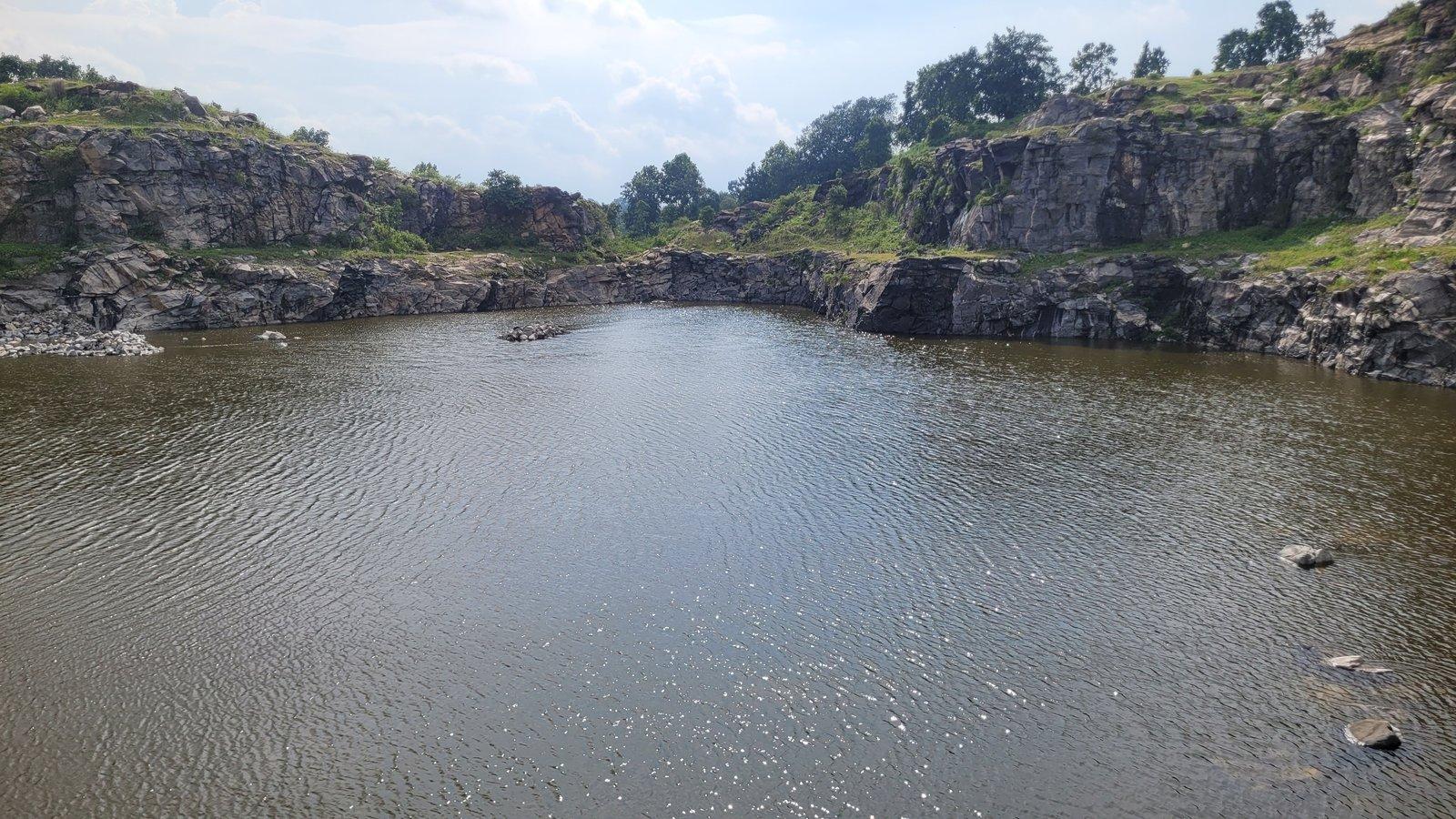
Tourism was a side effect. JICA noted that after the dams were built, local tourists began using the project area as a gateway to the Ajodhya Hills, that stalls sprang up around the Upper Dam, and that garbage left by visitors was damaging the landscape. Marble Lake, now one of the most visited spots in the hills, fills the quarry from which stone for the project was blasted.
Can you visit the Purulia Pumped Storage Project?
You can see both halves of it from public roads, which is how most visitors experience it:
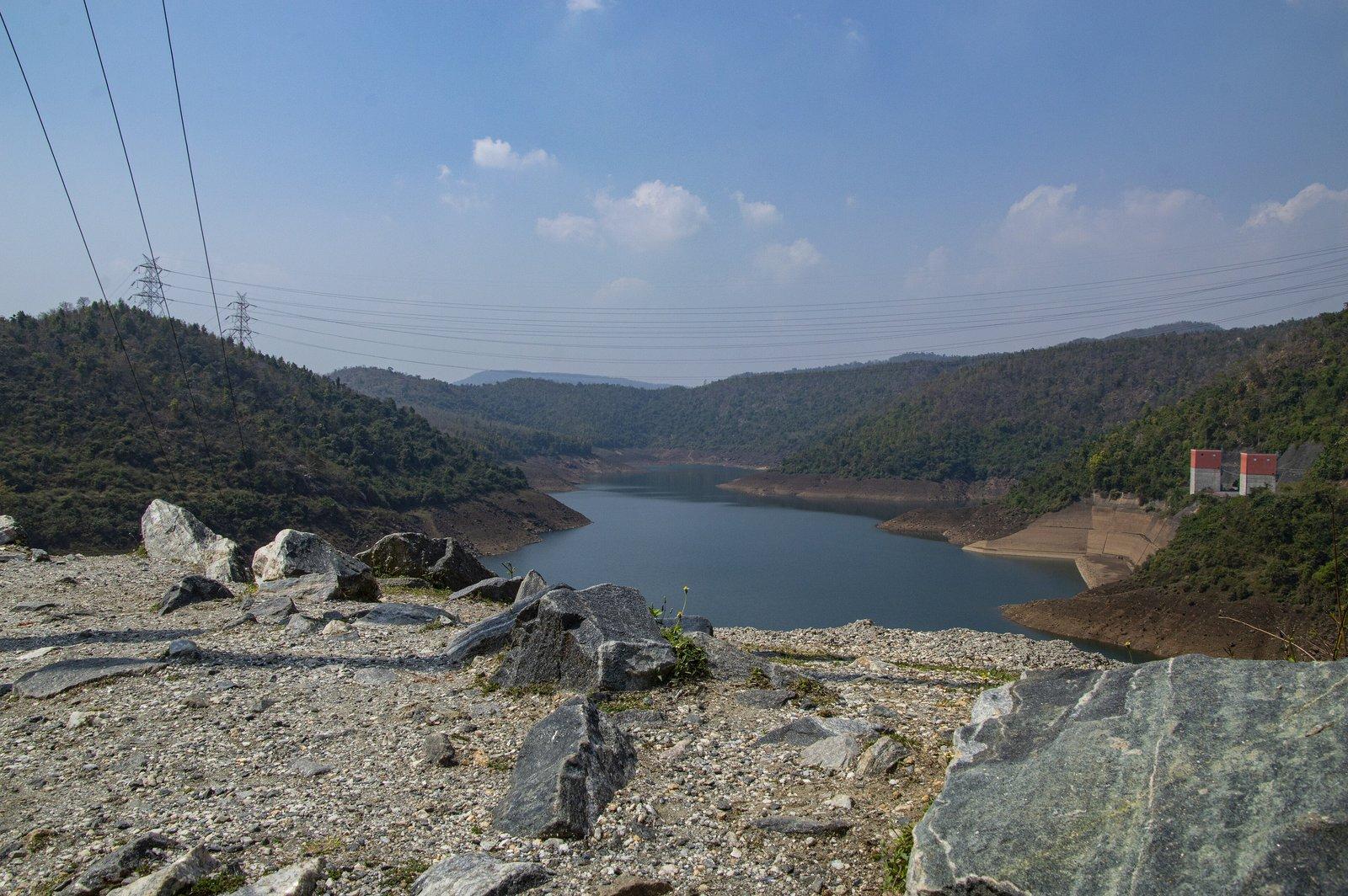
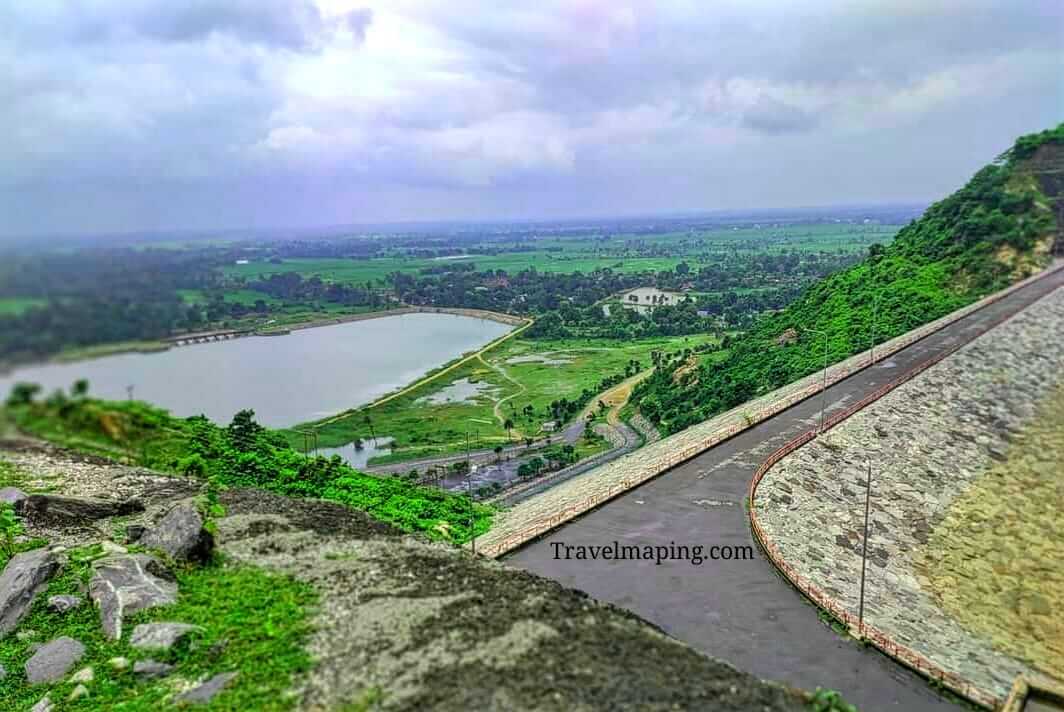
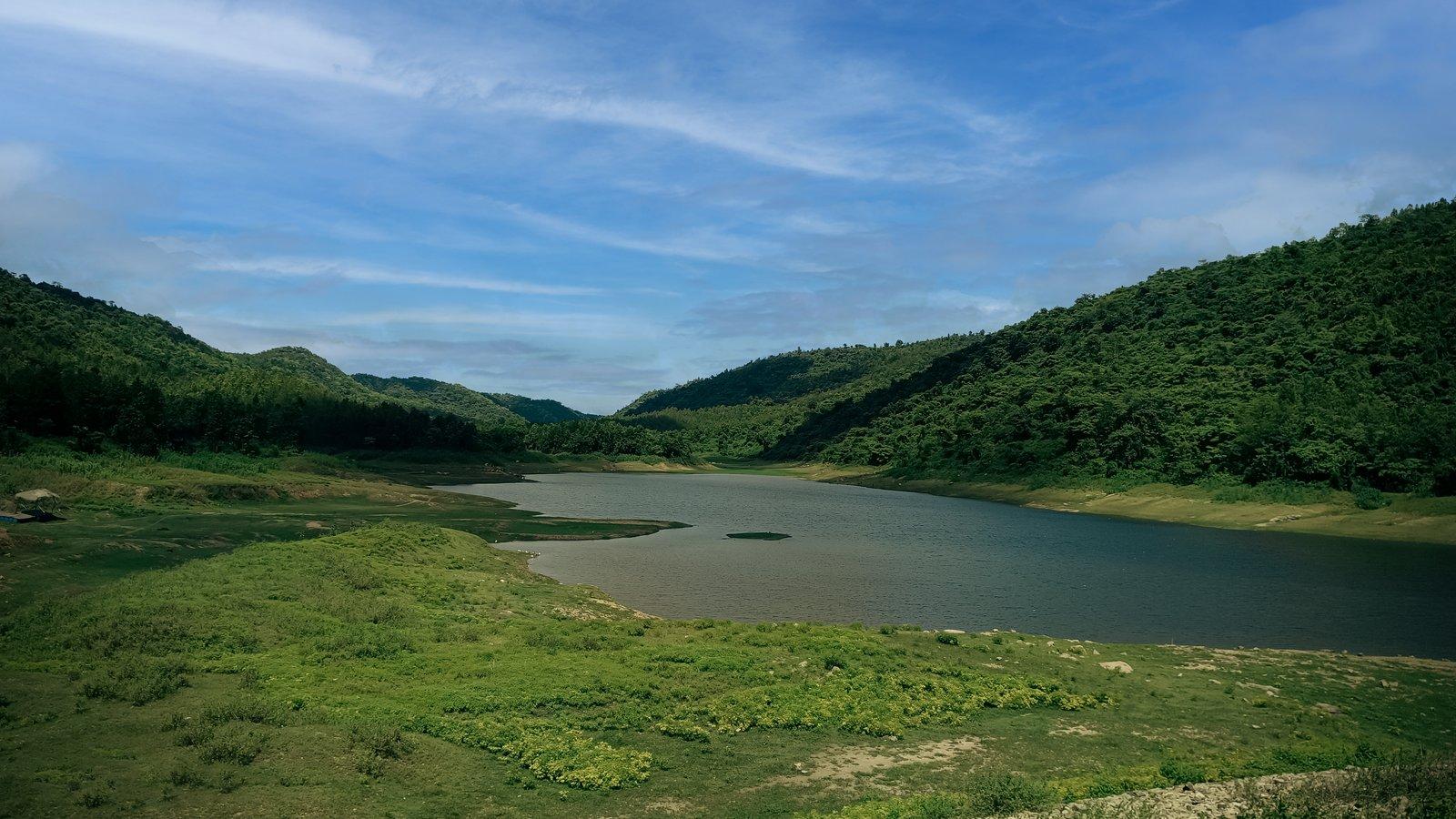
- Lower Dam (11 km from the resort): a roadside viewpoint looks along the lower lake one way and down over Lahariya Dam, its Shiva temple and the plains the other.
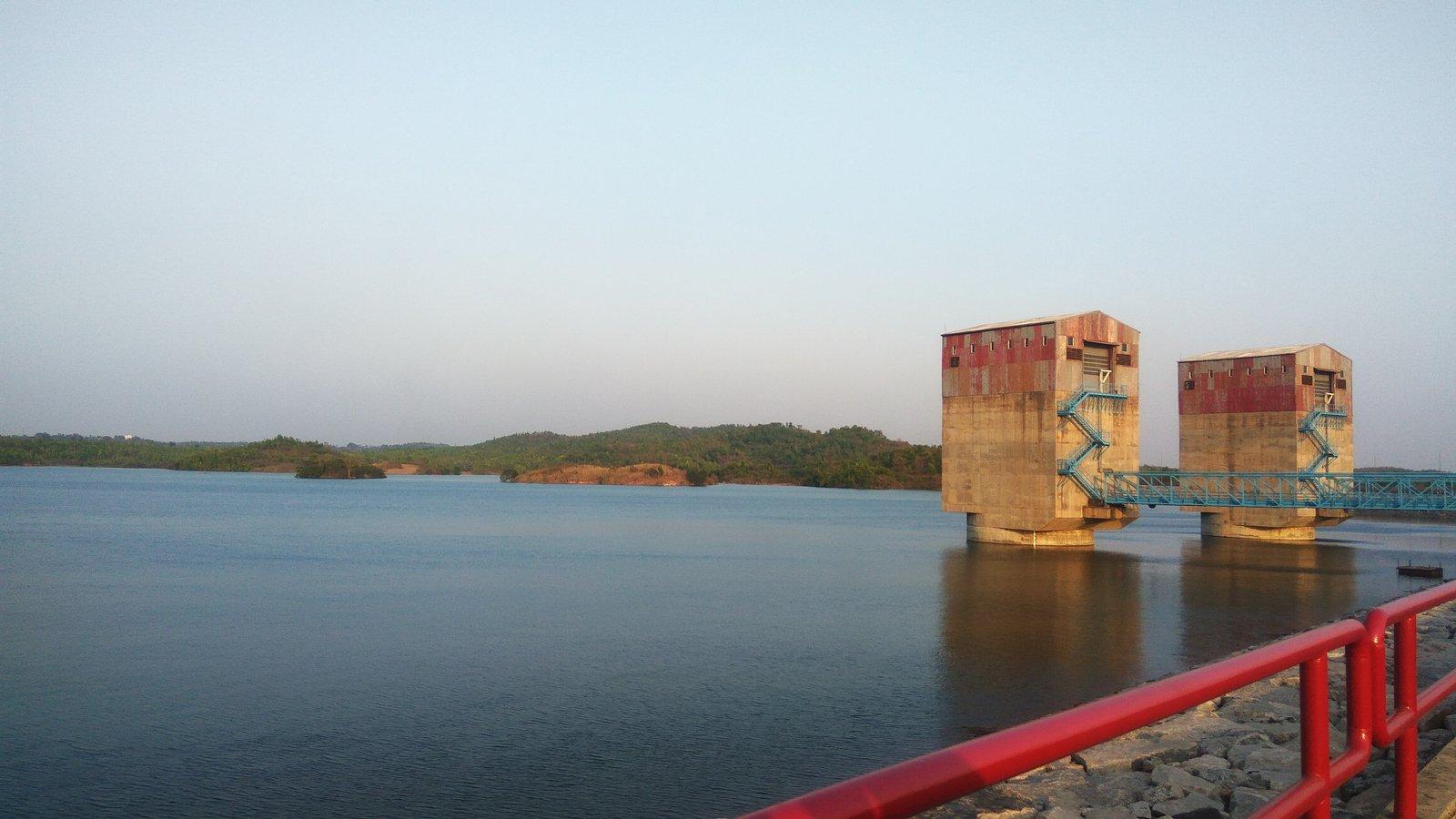
- Upper Dam (16 km from the resort): a road runs along the top of the embankment, with the reservoir on one side and forest on the other. Two concrete towers joined by a footbridge stand out in the water. A 2023 study rated it among the easiest sites in the hills for elderly visitors to reach.
We found no published entry fee, visiting hours or visiting arrangement for the underground power house, so treat the plant itself as a working installation that is not open to the public. Keep to the roads, keep off the embankment slopes and away from the water's edge, and follow any instructions from WBSEDCL staff. Ask before photographing installations, and don't fly a drone near them without checking the rules first.
Both dams sit on the usual circuit of the hills; our Ajodhya Hills travel guide and guide to Purulia's dams and lakes show how they fit into a day. From Rangamati we can arrange a sightseeing cab, driver or guide on request.
Turga: the next project upstream
Purulia was meant to be the first of several. The next, the 1,000 MW Turga Pumped Storage Project, would enlarge the existing Turga Dam into a lower reservoir and build a new upper dam up the same valley, with four 250 MW machines. JICA signed a first loan agreement for it in November 2018. The project has been contested by Santal villages and in the courts for years, over forest, grazing land and sacred sites, and in August 2026 a contractor was declared lowest bidder for its access road and main tunnel. Whatever happens next, the Ajodhya Hills' lakes and their power stations are likely to keep changing.