At a glance
- Santals are Purulia's largest Adivasi community: about 11.6% of the district's 2.93 million people at the 2011 Census.
- Santali is a Munda language with its own script, Ol Chiki, created by Raghunath Murmu in 1925; it entered the Constitution's Eighth Schedule in 2003.
- Sohrae, the main festival, honours cattle and the harvest; Santals in Purulia traditionally hold it around Kali Puja. Baha welcomes the sal blossom in spring.
- Dances are led by two drums, the tamak' and the tumdak' (also called madal), with women singing and dancing in lines.
- Visit villages only with someone the families know, ask before every photograph, keep away from sacred groves, and buy directly from makers.
Santhal culture in Purulia is a living way of life, not a show: the Santals, also spelled Santal, are the district's largest Adivasi community, and their language, faith, festivals, drums and painted mud houses shape the villages of the Ajodhya Hills and beyond. Visitors usually meet it through music and dance, at festivals such as Sohrae and Baha, or in the walls of a village repainted for the harvest. This guide explains the essentials and, just as important, how to visit with respect.
Santhal culture in Purulia: who are the Santals?
The Santals are one of India's largest Adivasi peoples, living mainly in Jharkhand, West Bengal, Odisha, Bihar and Assam, with communities in Bangladesh and Nepal. At the 2011 Census they made up about 11.6% of Purulia district's 2,930,115 people, by far the largest of its Scheduled Tribes; the next, the Bhumij, made up about 3.6%. Santali was the first language of about 11.2% of the district.
In the hills around us the Santals are part of a long, layered history. A researcher of tribal culture, Jaladhar Karmakar, told the newspaper Sangbad Pratidin that the Birhor were the first people of the Ajodhya Hills, followed by the Bhumij and the Santals, and that in Santali the hill is Ayodia, a mother who shelters everyone. The plateau's villages remain largely Adivasi.
The Santals are also central to the region's history of resistance. In 1855 they rose against British rule in the Santal Hul, led by the brothers Sidhu and Kanhu Murmu. Purulia's university, founded in 2010, is named Sidho-Kanho-Birsha University after them and the Munda leader Birsa Munda, and has taught Santali at postgraduate level since 2011–12.
Santali language and the Ol Chiki script
Santali belongs to the Munda branch of the Austroasiatic languages, a family quite separate from Bengali and Hindi. It was added to the Eighth Schedule of the Constitution in 2003 and is an additional official language of West Bengal and Jharkhand.
It has its own script, Ol Chiki, created in 1925 by the Santal writer Raghunath Murmu. It has 30 letters and is the official script for Santali in West Bengal, Odisha and Jharkhand, though Bengali, Odia, Devanagari and Roman letters are also used.
Purulia has its own Santali literary names. The poet Sarada Prasad Kisku (1929–1996), of Darikadaba village in Manbazar II block, wrote in Santali and spent his life campaigning against witch-hunting; he received the title Kavi-Ratna from Bhagalpur University in 1983.
Faith, sacred groves and village life
Many Santals follow their own religion, which is often called Sarna and, in West Bengal, Sari Dharam. At its centre is Marang Buru, "the Great Mountain", the supreme deity, along with the bongas, spirits who govern parts of the world. Others are Hindu or Christian. At the 2011 Census, 10.55% of Purulia's people gave a tribal religion.
Every traditional village has a jaher, a sacred grove at its edge where spirits live and the annual festivals are held. Village affairs are run by a council led by the headman, the manjhi, and important decisions are taken at the majhi than, a raised earthen place outside his house.
Sacred places are tied to the land itself. For the Santal communities of the Ajodhya Hills, a hillock called Marang Buru lies in the area of the planned Turga pumped-storage project, and villagers near Thurga Dam have opposed the project for years, citing forest, grazing land and sacred sites. It is a reminder that these hills are a homeland before they are a view.
Santal festivals: Sohrae, Baha and Karam
Santal festivals follow the farming year. Dates vary by village, so ask locally rather than relying on a fixed calendar.
- Sohrae, the principal festival, is a thanksgiving for the harvest, the cattle and everything that helped bring the crop home. The Santal writer Boro Baski describes five days of ritual bathing, offerings to family spirits, honouring and garlanding the cattle, and dancing from house to house. Many Santals hold it in Poush (December–January), but he notes that Santals in Purulia, Bankura and Medinipur still follow the older custom of celebrating it around Kali Puja. Read more in Bandna and Sohrai.
- Baha, the flower festival, welcomes spring and the sal blossom, usually around February–March. The priest, the naike, offers flowers and sal leaves at the jaher, then carries them from house to house, and the day ends in songs and dances to the drums.
- Karam, in Bhadra (August–September), centres on branches of the karam tree planted in the village ground. Around Murguma it is part of the monsoon.
- Disum Sendra, the hunting festival of the Ajodhya Hills, gathers people near Sita Kund around the full moon of Baisakh. Hunting is now illegal, and the forest department holds cultural programmes and community feasts instead.
Music and dance: tamak', tumdak' and the lines of dancers
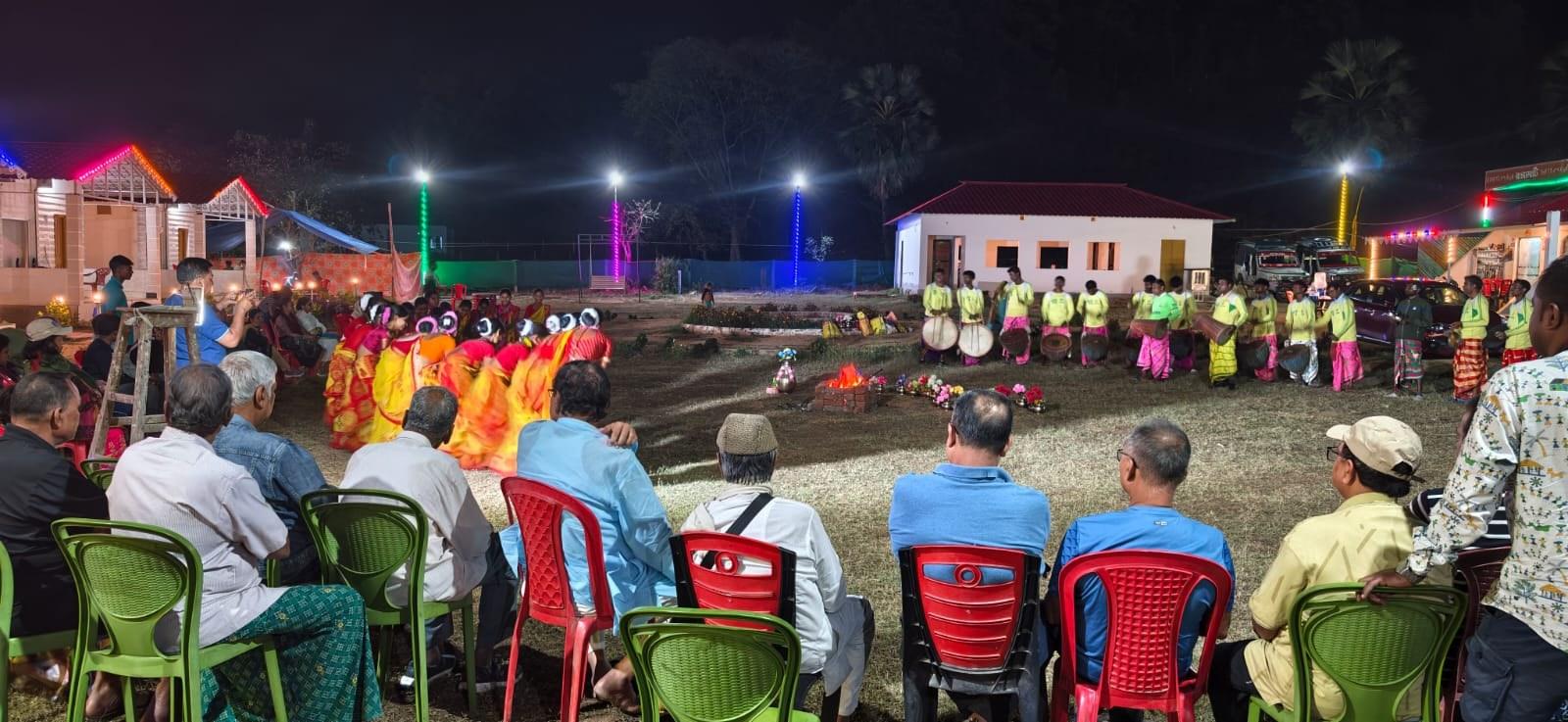
Santal music is built on two drums. The tamak' is a single-headed kettle drum beaten with two sticks and carries special spiritual weight. The tumdak', also called the madal, is a two-headed hand drum with a clay body, slung from the player's neck. Together they set the basic rhythm of Santal dance.
Two more instruments are worth knowing. The banam is a bowed lute, often carved from a single piece of wood with a human head at the top, and the tiriao is a bamboo flute associated with love. Men play most of the instruments; women sing together in groups.
Most tunes belong to particular festivals, so a Sohrae song is not a Baha song. In the dances visitors usually see, women in matching saris link arms in long lines that sway and step together, while the men drum in front of them.
Painted walls: Sohrai likhan
Before Sohrae, Santal women in northern Purulia traditionally repair, plaster and decorate the mud walls of their homes. The Daricha Foundation, which has documented the practice since 2016, describes the process: a base of diluted cow dung, a coat of poli mati, a pale worm-cast soil, and then designs traced into a wet slip with the fingertips, often three or four fingers drawn in parallel. The plinth is painted last in black made from burnt straw.
The motifs are mostly floral and geometric. Villages such as Hatimara in Hura block, Dhagora in Para block and Amaidih in Neturia block are known for painted houses, and so are some villages in Bagmundi and Jhalda blocks. The tradition is shrinking as brick replaces mud, which makes any surviving wall worth seeing with care. For how this differs from the Warli art used on our website, see Warli art and the painted walls of Purulia.
How to visit Santal villages responsibly
The most important rule is simple: Santal villages are homes, not attractions. A few practical guidelines follow from it.
- Go with someone the families know. A local guide or driver can tell you whether a visit is welcome. Do not walk into courtyards uninvited.
- Ask before every photograph, and accept a no. Be especially careful with women, children, elders and anything to do with worship.
- Keep away from sacred places. Do not enter a jaher or touch shrines and offerings, and never photograph a ritual without clear permission.
- Don't treat festivals as a show. If you are invited to watch, stay at the edge, follow the hosts' lead and leave if the mood changes.
- Buy directly from makers and performers, and pay fairly. Don't hand out sweets, pens or money to children.
- Leave no trace. No litter, no loud music, no drones over villages, and drive slowly through them.
Santhali dance at Rangamati
The easiest respectful way for guests to enjoy Santal music is a performance arranged for that purpose. At the resort we can arrange a Santhali dance with drummers on the lawn on request; it is a chargeable service, so mention it when you book. See our evening experiences for details, alongside Chhau and Baul songs.
To go further into the region's culture, read our guides to Purulia Chhau dance, Jhumur songs and the history of Manbhum and Purulia.